In most law schools, criminal law lasts the first semester. It will be your sole grade for all the work you did in the fall. If you do poorly in your other classes, you can make it up during second semester; not so criminal law. There is no way that your GPA can recover from a poor grade in Criminal law first semester - and if you are planning on being on law review, clerking for a federal judge, or working for a boutique law firm it is absolutely essential that you do well in criminal law.
When firms come to interview in the spring of your first year, the only grade they have to go on is from criminal law. Firms like to keep the people they pick up first year. If you can land a clerkship first year and you perform well you might get an offer to clerk second year. If you do well the second year, you might get a job offer during third year. As you can see, criminal law is important in that it starts the parade of horrors that leads to job at a good law firm.
During your criminal law course, you'll study lots of different concepts.
- you'll start with the reasons behind punishment,
- then you'll move to the concepts of culpability, proportionality, and legality.
- Finally, you'll apply all that you've learned to the systematic study of different crimes. You'll examine murder, burglary, rape, conspiracy and others.
Your study of the Criminal law starts with an examination of punishment and the theories behind it. I didn't understand the big deal. "we punish people because they deserve it, right?" Well, not really. We don't know why we punish people because we will never be able to measure conclusively the efficacy and benefits of punishment. Notwithstanding our lack of omnipotence, there is a multitude of policy arguments for and against punishment.
When I asked my wife she said "People are punished because we want to make them better; we want to reform them so they don't break the law." Although this sounds a little Clock-Work-Orangish, this is definitely one of the reasons for punishment. The legal scholars call this rehabilitation. This is a very liberal theory and has had two major periods of popularity: The late 19th century and the 1970s.
Another theory is retribution - we punish because people deserve it. This is the eye for an eye, tooth for a tooth theory of punishment. Retribution is the oldest rationale for punishment and it remains, in my opinion, the strongest argument. Think about the mass of people at Ted Bundy's execution waiving posters reading "let me pull the switch!" and "Ted-b-que." These people were expressing a primitive thirst for vengeance; a pre-historic appetite for destroying deviants. Many theorize that this thirst is healthily satisfied by state sponsored retributive punishment.
Another theory of punishment is incapacitation. We punish people to incapacitate them. Society removes wrong-doers to protect itself.
A final theory is that we punish to deter the criminal, and to deter society at large from committing criminal acts. Deterrence of the criminal is called specific deterrence. When a law violator is punished the criminal won't want to be punished again and is deterred from future criminal acts. Deterring society at large is general deterrence; When society observes the effect of punishment on the criminal, individuals are deterred from criminal activity.
- reformation
- retribution
- incapacitation
- deterrence
The debate on why we punish is extremely important. A criminal prosecution involves high stakes for the defendant; At trial, the accused will defend his freedom and if the charge is a capital offense, his life. Life is a precious commodity. Its not surprising that safeguards have grown up to protect defendants from arbitrary and capricious prosecution.

-- Rerum Gestarum, lib. 18, c. 1.
You've heard about the two keystones of American justice: 1)innocent until proven guilty and 2)guilt beyond a reasonable doubt. Both the presumption of innocence and the 'beyond a reasonable doubt' standard protect the innocent from wrongful conviction.
As the quote above stresses, it is not enough to be accused -- the prosecution has the burden of showing beyond a reasonable doubt that the defendant committed the charged crime. The presumption of innocence and its expression in the 'beyond a reasonable doubt' standard serve two main functions.
First, the standard protects the defendant by guarding against factual errors in a prosecution. Each and every element of a crime must be proven beyond a reasonable doubt. Juries should not be swayed by ambiguous facts - the jurors must have a very high degree of certainty about each and every element of a crime to convict. Many commentators express this preference for protecting the innocent as "better ten guilty men go free then one innocent man be punished."
Second, the 'beyond a reasonable doubt standard' also protects the judicial system by maintaining the public's confidence. If the innocent are punished along with the guilty, there is no incentive to obey the law. Establishing a high burden of proof and erring on the side of letting the guilty go free ensures that the state punishes very few innocent people. Commentators theorize that this strengthens our confidence in the legal system and increases our willingness to obey the law.
While we easily understand the function and the need for these concepts, trying to define 'beyond a reasonable doubt' is not easy and jurors and lawyers alike often struggle with the standard.
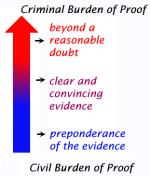 A good starting point is to contrast the burden of a criminal prosecution with that of a civil plaintiff.
In civil suits, such as contract, tort and property conflicts, the plaintiff must prove the
defendant's liability (notice that guilt and liability are
two different concepts) by a preponderance of the evidence. This is a more likely than
not standard. In criminal law the standard is much higher in that the prosecution
(notice that in a criminal trial the 'plaintiff' is the state, the prosecution) must
prove beyond a reasonable doubt the defendant committed the crime in question. Further, crimes
are divided into elements -- a fact we'll discuss shortly -- and the prosecution must prove
for each element that the defendant was culpable beyond a reasonable doubt. So, we
know that the standard for criminal cases is higher than that of civil cases.
A good starting point is to contrast the burden of a criminal prosecution with that of a civil plaintiff.
In civil suits, such as contract, tort and property conflicts, the plaintiff must prove the
defendant's liability (notice that guilt and liability are
two different concepts) by a preponderance of the evidence. This is a more likely than
not standard. In criminal law the standard is much higher in that the prosecution
(notice that in a criminal trial the 'plaintiff' is the state, the prosecution) must
prove beyond a reasonable doubt the defendant committed the crime in question. Further, crimes
are divided into elements -- a fact we'll discuss shortly -- and the prosecution must prove
for each element that the defendant was culpable beyond a reasonable doubt. So, we
know that the standard for criminal cases is higher than that of civil cases.
For a more indepth definition of reasonable doubt see what the Supreme Court has to say about the concept.
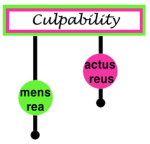 One question central to the philosophical underpinnings and practical
application of criminal law is, "who deserves to be punished?"
One question central to the philosophical underpinnings and practical
application of criminal law is, "who deserves to be punished?"
Society must have a bar -- some bright line -- that separates the guilty from the innocent. We must be sure that we won't be punished unless we deserve it. To determine who deserves to be punished, our judicial system has evolved a two part analysis involving 1) action, coupled with 2) intent.
That is, each and every act that the law considers criminal must be accompanied by a particular pre-defined type of intent to perform the prohibited act. The prohibited act is called the Actus Reus (act-us-ray-oos) and the criminal intent that must accompany each prohibited act is called the mens rea (mens-ray-ah).
You've heard of manslaughter, and you've heard of murder. What's the difference? You know the prohibited act of killing a person, i.e. the Actus reus, is the same for both crimes. So, the accompanying mental state, the mens rea, must be what distinguishes murder from manslaughter. Murder is killing another person on purpose and manslaughter is recklessly taking the life of a person.
You may want to explore some of the subtleties of the Actus Reus.
Every crime needs an action, the actus reus, and at the same time every crime must have intentionality. With out intent, there can be an action, the death of a person for example, but no crime. Further, each act that makes up the definition of a crime must have a corresponding intent.
All crimes consist of elements, actions coupled with levels of intentionality -- actus reus + mens rea.
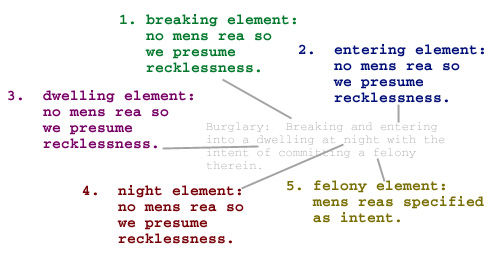
For example, the crime of burglary is defined by many jurisdictions as: breaking and entering in to a dwelling at night with the intent to commit a felony therein.
- a breaking (which means something like forcing open a door or window)
- an entering
- in to a dwelling
- at night
- with the intent to commit a felony therein.
So to commit Burglary you would have to:
- know that there was a substantial risk that you were breaking (as opposed to merely being invited to enter in).
- know that there was a substantial risk that you were entering
- know that there was a substantial risk that the place you were breaking into was a dwelling (as opposed to you thinking the spot was a bar where you could get a beer).
- know that there was a substantial risk that it was night
- notice that the last element -- committing a felony -- has a mens rea of intent. So you would have to intend, i.e. it would have to be your conscious object or purpose, to commit a felony in the dwelling you broke and entered into at night.
In this section, I've given you a brief overview of criminal law. The rest of your semester will be spent studying the elements and defenses of the different crimes.
One thing you should be warned about is the model penal code.
As to the final, it will be structured like this: You'll have some God-awful fact pattern with people blowing each other up, and planning to blow each other up, trying to blow each other up and failing. People cutting off heads, stealing cars, robbing banks, breaking into houses and raping . . . All you have to do is identify each crime. State the crime's elements. State the mens rea that applies to each element. Mention the burden of proof. Apply the facts in the question to the rule, i.e. the elements + mens rea. You will get at least a B following this method. All the theory we talked about above won't be on the exam. You'll spend weeks talking about it, and never see it again.
Do well. Its important.