What are you going to study in property law? You aren't going to study real estate transactions You won't learn how to close your own mortgage.
In property you will study what it means to "own" something. This might seem like a very simple concept but it isn't. How do courts determine who "owns" something? And exactly how much of a thing can a person "own"? You will study how one acquires "rights" to a thing, and how broad these "rights" are.
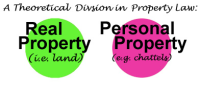 Lawyers recognize
two different types of property, real and personal. Real property
is rights in land, and personal property is rights in anything else.
First year property
courses are usually organized to some extent upon this division.
During the first weeks of class you will study personal property and this
will lay a foundation for tackling the rest of the course.
Lawyers recognize
two different types of property, real and personal. Real property
is rights in land, and personal property is rights in anything else.
First year property
courses are usually organized to some extent upon this division.
During the first weeks of class you will study personal property and this
will lay a foundation for tackling the rest of the course.
A few examples of personal property include rights in: Copyrights, patents, cars, animals, watches, a painting. Sometimes lawyers refer to these things as chattels, things capable of being moved. But not all personal property are chattels; some, like patents and copyrights are intangible and can't really be moved or considered chattels. Sometimes, as a shorthand, you will see personal property referred to as "personalty." [note the spelling]
Have you noticed that we aren't talking about owning the physical object itself? Instead we talk about the rights associated with that object.
In the best Socratic Style let me ask you some questions: When you buy a car are you buying the physical steel and plastic object? Or are you buying something else?
 Instead of buing a car, you are really buying a whole
bundle of rights associated with the car. Legally expectations
are called "rights." Property law is concerned mainly with these rights or
expectations.
Instead of buing a car, you are really buying a whole
bundle of rights associated with the car. Legally expectations
are called "rights." Property law is concerned mainly with these rights or
expectations.
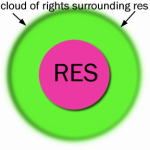 The Latin word for "thing" is "res." Lawyers call the underlying thing in
property law the "res". In your Property class, you are concerned with this
bundle, this could, of rights surrounding the res.
The Latin word for "thing" is "res." Lawyers call the underlying thing in
property law the "res". In your Property class, you are concerned with this
bundle, this could, of rights surrounding the res.
The res might be land, a car, a watch, or any object. In fact we invent new "reses" all the time -- new financial instruments, new expectations as employees and stockholders, new rights in land, for example.
From the res, emanates a cloud of rights that people can claim. There are all types of different rights you could have in relation to the res. You could lease the res. When the lease is over, the lease-right you had returns to the person who leased you the res. The lessor has the right to get the res back and lease it again. The interest that returns to the lessor is called a "reverter interest" and it, too, is a property right.
Over the centuries lawyers have developed all kinds of property rights. As you might imagine, since land is very important to individuals and society, the rights associated with land are very, very complicated. Also, rights associated with land tend to be very conservative -- that is, these rights do not change often; this promotes stability and a degree of certainty in land law. These different rights in land are often called "estates in land". Some "estates" you are already familiar with like the lease on an apartment or a easement across someone's land. Others are more arcane like the reverter interest mentioned above or a "fee tail" estate.
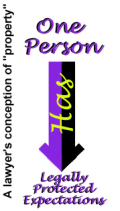
The idea of "rights" is essential to your understanding of property law. You can think of a "right" as the ability to get the state to use force if necessary to protect your interests. Rights are the cloud around the "res." Rights come about, ultimately, through the use of executive force -- whether that force is police or military -- coupled with judicial endorsement. The courts determine what the res is and the police ensure that the res is honored by others.
One of the fundamental rights in land is the right to be able to keep other people from using your land. The right to keep others from trespassing, i.e. the right to keep people out, is at the core of property law. Courts determine if you have such a right and the police force others to respect your rights.
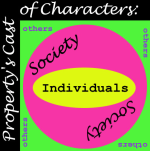 If Property were a play on Broadway, it would have
three distinct groups of characters: 1) The
individual claiming rights in a thing; 2) other people who might interfere
with the individual's expectations, and 3) Society - more specifically
the legislatures, courts, and police - which protects rights.
If Property were a play on Broadway, it would have
three distinct groups of characters: 1) The
individual claiming rights in a thing; 2) other people who might interfere
with the individual's expectations, and 3) Society - more specifically
the legislatures, courts, and police - which protects rights.
How do we know who "owns" property, and how does society come to the conclusion that a person has an exclusive right to a thing? If you find something how do you know if it belongs to you? What happens to the rights of the person who lost the item? Who owns wild animals, gas reserves, undiscovered continents? What if two people buy the same piece of property? These might seem like unpractical questions. They are not. These questions must be answered for society to be stable. Property law fills this need and you will study cases that answer these questions.
The easiest way to get rights in a thing is by buying them. If the prior owner held all of the rights, all of the green cloud emanating from the res, then the new owner will have all of the rights to the thing. This concept of the greatest amount of right possible in a thing is called title The idea of title is very close to the lay person's idea of ownership.
If someone tries to interfere with your rights in a thing you will have to go to court. The court will determine who has "possession" of the thing in question. If the court determines that one party has more right in a thing than another. Possession is a legal word that means that one party has a greater right to the green cloud of rights emanating from the res than another party. Possession is a legal conclusion that someone has rights in a thing.
Two ways to get legal possession in a thing are finding and capture.
Many years ago, people hunted whales for their oil. Whaling was difficult and dangerous. Sometimes after harpooning a whale, it would escape. To minimize disputes, hunters put unique marks on their harpoons. When someone found a dead whale either in the ocean or on the beach with one of these marked harpoons in it, everyone agreed that the best policy would be to give the special harpoon owner the greatest right in the whale.
It won't come as a great shock to you that the above whaling fact pattern comes from an actual case. Ghen v. Rich. 8 F. 153.
Title is the legal conclusion that a person has possession of a thing good against the whole world. Possession is a legal conclusion by a court that a person has a greater right to a thing than another person. One rule that helps courts conclude that a person has possession of a thing is the rule of capture. The rule of capture can be extended and at least one court has followed this extension. There are other rules that will lead a court to conclude that a person has possession. They include the rule of find; the rule of discovery; the rule of adverse possession; and the rule of creation. We have not discussed these rules here, but you will study them your first semester. Another definition of possession that lawyers often use is physical control of an object. While physical control of an object might be good evidence that a person has legal possession, it is not conclusive as we saw in our girl and hunter example, above.
You will cover the above material in the first two or three weeks of your property course. If you get a general feeling for the above concepts, you will have a foundation that will help you understand the material to come.
During the the first semester, you will also cover Estates in Land, gifts and adverse possession.