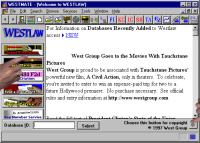
As you might know, West is the largest legal publisher in the United States and they offer some truly incredible services. One service is access to their huge database through WestLaw. Their database contains almost every single promulgated legal opinion, law review article, and newspaper and magazine article published, ever.
At most law schools you won't be able to access the service until after the end of your first semester. West's biggest competitor is Lexis-Nexis, but at the law school I attended they did not have much of a presence and their software left a lot to be desired. With the ascendency of the Web, West enabled access to its database through the internet. See www.westlaw.com.
The expanse of WestLaw and Lexis-Nexis is daunting, but as accessibility and dissemination of information continues to grow it is not clear that the two companies will be able to maintain their strangle-hold on the delivery of legal information. For example, almost every state now publishes its statutes and legal opinions online. And many private vendors now are selling legal information (check out lawskills.com for access to free Georgia Law).
Recently, West and Lexis-Nexis have found themselves the subject of several law suits concerning schemes to fix the price of legal information: Information that your tax dollars pay to produce and publish! Also, West recently lost a case concerning the extent of their copyright in government works. The world is changing in amazing ways. You are the first generation of lawyers to have nearly free access to a wealth of legal information.
LawSkills.com has links to free legal databases.
While you are in law school you will get a free subscription to Westlaw, and Lexis-Nexis. Crack-rock. Rest assured that as soon as you graduate, the free ride ends. Both services are notoriously expensive. One teacher told me of a clerk he supervised on the Nevada supreme court. Without the teacher's knowledge, the clerk had been doing all of his research online. By the end of the summer, the supreme court had a Westlaw bill of over $20,000. Urban myth? Maybe. The point is that the services are expensive so you must learn to do your research properly -- in the books. Mastering the traditional methods of legal research will enable you to use the electronic tools efficiently. Your employer will keep you around if you do.