You won't see any "contracts" in your contracts class. Your going to read cases about contracts. These legal opinions will be centered around the central theme of the course, the enforceability of promises.
Here we are going to focus on "consideration", the first bar in getting a court to enforce a contract. Consideration is an ancient and confusing doctrine, but its effect is simple to understand: A contract lacking consideration is unenforceable.
--O'neil v. Phillips, 83 Ga.556, 10 S.E. 352 (1899).
We make all kinds of gratuitous promises every day. We make promises we never intend to keep. We may tell an intern that we will send that letter of recommendation to the law school admissions committee, but we forget. Or we make a promise to help a friend move. We discover later that our wife has other plans.
Can the intern sue us? Would our friend go to court to force us to help them move? Of course not.
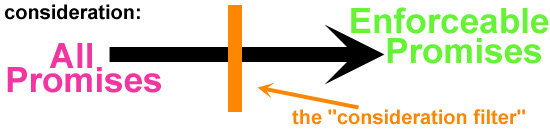 Early in the history of modern agreements, the English courts developed the
doctrine of consideration to prevent unintended and gratuitous promises from flooding
the legal system.
Consideration is a bar that keeps gratuitous promises out of court; at the same
time it enables courts to enforce legitimate ones.
You can conceptualize the doctrine of consideration as a promise filter.
Early in the history of modern agreements, the English courts developed the
doctrine of consideration to prevent unintended and gratuitous promises from flooding
the legal system.
Consideration is a bar that keeps gratuitous promises out of court; at the same
time it enables courts to enforce legitimate ones.
You can conceptualize the doctrine of consideration as a promise filter.
Look at this diagram of a typical exchange. Let's examine
a few things about it. Notice how nothing has changed hands
except promises. Pink has promised to give £100. And Green
has promised to deliver 5 horses. Notice that both Pink and
Green are giving promises. If we are going to label the diagram both Pink
and Green are "Promisors."

Now, notice that both Pink and Green received promises. Green received Pink's promise to pay; Pink received Green's promise to deliver. In the law we use the technical term "Promisee" to describe a person who has received a promise from a promisor. Pink and Green are both promisor and promisee in the transaction.
Now let's take a moment to position ourselves in a hypothetical law
suit. Let's again pretend that Green promised to deliver horses and Pink promised
to pay £100 for the horses. Green goes off happy that he has
made a good deal. Later, Pink finds horses at a better price and buys
them instead, disregarding the prior agreement with Green. Green brings
a lawsuit against Pink to enforce Pink's promise.
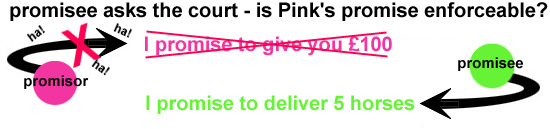 The central
issue
in the suit is:
Will the court enforce Pink's promise to Green to pay for the
horses?
To determine if the promise is enforceable,
the court turns to the the consideration filter.
The central
issue
in the suit is:
Will the court enforce Pink's promise to Green to pay for the
horses?
To determine if the promise is enforceable,
the court turns to the the consideration filter.
The labeling of the parties to the suit is extremely important. This skill - labeling the positions of the parties - eluded me first year. I didn't understand its importance. So, heads up and pay attention because this is one key to the kingdom of contracts.
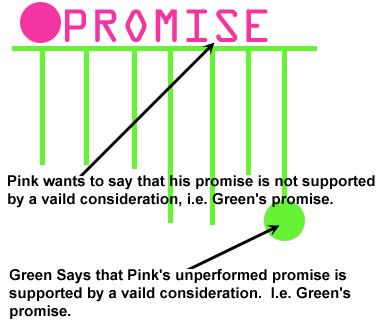
In this hypothetical lawsuit, Green is trying to get the court to say that Pink's promise is enforceable. And, or course, Pink will argue that his promise is not enforceable. We are concerned with Pink's status as a promisor. But more importantly we are concerned with the promisees promise -- this is where we will focus our attention next.
Over the centuries, through many legal opinions, law reviews and treatises the doctrine of consideration has been refined. The present, modern definition comes from Oliver Wendell Holmes' The Common Law.
- There must be a detriment to the PROMISEE;
- This detriment must have been bargained for by the promisor in exchange for the the promisor's promise.
Here we are focusing on Green (the promisees) promise: was there a legal detriment? Was that detriment bargained for by Pink (i.e. induced by Green's promise)?
A promisee, like Green, incurs a legal detriment whenever he does something he has no legal duty to do. Here, a court will find that Green's mere promise to deliver the five horses is a legal detriment. Notice, merely promising to do something in the future is doing something you don't legally have to do. Thus, courts define promises as legal detriments.
Confusingly, courts also consider promising not to do something a legal detriment. This is called forbearance. An example of forbearing is refraining from drinking or smoking. If someone bargained with you to promise to forbear from smoking for one year in exchange for $100, then you have incurred a legal detriment. If they refuse to pay after your performance then you, as promisee, can sue to enforce that broken promise.
 The second element of the consideration filter is the bargain requirement.
Determining if something was bargained for is a very subjective and fact specific inquiry. Each case is different. On the same facts, one court may determine that there was a bargain; another court my say there was no bargain. How can you tell if a promise induced another promise? The best we can do to determine if something was bargained for is look at the facts of the case. Does it appear, in your opinion, that one party's promise induced the other party's promise?
In our hypo we might say: yes, Pink bargained for Green's promise to deliver horses. We might look to the parties' behavior, the dynamics of the market place, other players in the market at the time of Pink and Green's transaction, the customs of the horse trading industry. . . The point is that the inquiry will be fact intensive and there is no hard and fast way to determine if a bargain exists.
One way casebooks try to show you a valid bargain is by showing you deals that are not valid bargains (negative definitions -- the foundation of law school).
The classic no inducement hypo is the example of the "professor and the tramp." A professor, feeling guilty for ruining the lives of so many law students, finds a tramp that needs a meal. "Follow me around the corner, and I'll buy you lunch," promises the professor. The tramp promises to follow the professor. Then the professor, feeling like she's done enough good for the day, decides to renig. "Nope, I don't feel like eating with you today." The tramp sues for breach of contract. Was there a bargain?
No. The tramp suffered a detriment in promising to go to lunch, but the professor wasn't induced by the tramp's promise to follow. The professor wanted to feed the tramp -- following around the corner was just necessary for getting the meal. The professor was induced by her own desire to feed a random tramp.
Regardless, No detriment + no bargaining = no consideration.
This section contains a link to the case Silver v. Starrett. This real-world opinion demonstrates a court's use of the consideration filter to determine if a broken promise can be enforced.
At issue is an unmarried couple's separation agreement. One party, Rich Doctor, wanted her live in lover, Live-in, to move out. Rich Doctor wanted this so badly that she promised the Live-in several years of "palimony" payments. The Live-in said, "hey, this is a good deal. She promised to pay in exchange for me moving out ASAP."
You can guess what happened. The Live-in moves out, and Rich Doctor refuses to pay. The Live-in sues Rich doctor claiming that Rich Doctor's broken promise was supported by adequate consideration. The issues: Did Live-in incur a legal detriment by moving out? Was Rich Doctor induced by the promise to move out? The court answers both questions in the affirmative.
During the year, will will explore consideration, contract formation, offer and acceptance, the statute of frauds, the pre-existing legal duty rule, the parol evidence rule, illegality . . . As you see, the list is daunting. Here, I've introduced you to the concept of consideration. It's murky, convoluted, and not particularly endearing. Personally, I think that since the bargain requirement of the consideration test is so fuzzy, the entire test is illusory: bargains are found where bargains "need" to be found.
Regardless, courts use the consideration filter to weed out gratuitous promises.