If you've read a legal opinion, you probably noticed that it was filled with confusing jargon and hard to follow legal reasoning. You probably didn't notice that it was a technical document made up of very specific legal and factual elements.
The poor organization of many opinions makes them hard to understand. Not only are the legal elements hard to identify in an opinion, but they are also hard to locate since there is no set standardized form, no stock beginning, middle, or end of an opinion. For example, a court may start an opinion with a rule of law. Another may start with a summary of the facts.
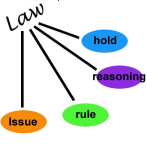
A good legal writer might organize an opinion as follows:
- a brief statement of the procedural stance of a case;
- a summary of the court's hold or reasoning;
- a brief statement of the facts;
- a statement of the issue.
- a concise statement of the rule; and
-
an explanation of the court's reasoning showing how it came
to apply a particular legal rule to the facts at hand (the hold).
 One of the biggest mistakes you can make in law school is to read a case
from beginning to end as if it were a story.
You must learn how to read opinions as
technical legal documents. The opinion is the raw material for most of your
work in law school but reading opinions is not the work your ultimately
responsible for. Your real assignment is
briefing opinions, i.e. plucking out the legal elements and
to synthesizing the hold!
One of the biggest mistakes you can make in law school is to read a case
from beginning to end as if it were a story.
You must learn how to read opinions as
technical legal documents. The opinion is the raw material for most of your
work in law school but reading opinions is not the work your ultimately
responsible for. Your real assignment is
briefing opinions, i.e. plucking out the legal elements and
to synthesizing the hold!
You will have so much work to do first year that you will be tempted to skim through your opinions without identifying the different elements and without writing a brief. You may be tempted into thinking that reading your cases is enough preparation. You're missing the entire point of law school if you work like this. I am speaking from experience.
The issue of an opinion is the legal question that the court must answer to resolve the case. It is the fundamental legal dispute between the parties.
A practical way to find the issue of a case is to ask, "Why did the authors include this case in my book?"
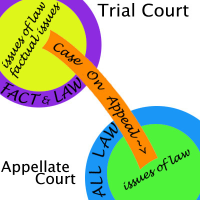 Do not confuse "fact issues" with "legal issues". In law school, you are
concerned with legal issues.
Factual issues are determined at the trial court level
because it has the best position, with the litigants before it, to
determine the "truth."
Do not confuse "fact issues" with "legal issues". In law school, you are
concerned with legal issues.
Factual issues are determined at the trial court level
because it has the best position, with the litigants before it, to
determine the "truth."
The appellate courts that write the opinions in your books give a lot of deference to trial courts' determinations of the facts. Rarely will they overturn such conclusions. In the odd case where a trial court's determination of the facts is clearly erroneous, an appellate court may step in and state what facts the trial court "should of found" or "should have emphasized." But this playing with the facts is very rare.
A rule is a legal principle. Rules come from two main sources, case law and statutes. Sometimes a court will look to policy for rules. These policy type rules might be derived from economics, custom, pure politics or whatever in the judge's opinion rises to the level of a rule.
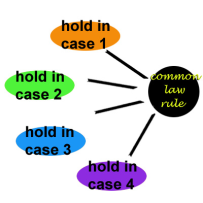
The common law is the grand history of our court system embodied in every decision ever made within a particular jurisdiction. You can think of the common law as judicial legislation or judge made law. "Wow," you might be saying (if you haven't dozed off), "I thought that only legislatures make law." No! By deciding cases judges are in fact, determining HOW a particular rule is applied in a particular circumstance. This is called the HOLDing of the court. Each court of lesser power is now bound by how the court held in that particular case. So, the appellate court's interpretation of a rule, its application of a rule, has now become a rule that courts of lesser power must follow.
Let me state this again. Each time a court makes a decision based on a rule, it is interpreting that rule. The way the court used the rule to make a decision becomes a rule in and of itself. Confused? A little discussion on the role of stare decisis might help.
Rule making in the common law tradition - i.e. court made law - is constrained by the doctrine of stare decisis. First, stare decisis is a vague doctrine. Basically, it has two major themes:
- When a court comes to a conclusion on an issue of law when certain facts are
present in a particular controversy, it should always come to the same
conclusion when substantially similar facts again are present in a different
controversy.
- The judiciary is hierarchical. There is a supreme court followed in power by an appellate court, and finally a court of origination. Each court within the hierarchy must adhere to the decisions of courts superior in the hierarchy. When an inferior court is presented with a case with substantially similar facts, it must follow the lead of the more powerful court.
These two points mean that the judiciary is very conservative. Lower courts can't break ranks and decide cases in totally novel ways, and the more powerful courts mostly abide by previous decisions. I say "mostly" because sometimes, in the name of justice, when the application of a rule is manifestly unfair, or when the political pressure to change a rule is too great to withstand, a court will make a dramatic turn from precedent, a dramatic departure from stare decisis. Thus a new precedent is established and when substantially similar facts occur, that court and all courts beneath it in hierarchy should follow the new decision. This flexibility and the ability to break with rules that impede justice is also a part of the doctrine and power of stare decisis. It is no rigid principle.
- case law
- statutes
- other -- rare -- (policy, principles, customs, etc. . .)
During my first year of law school I was frustrated because I didn't understand how the judges were picking which rule, out of the entire universe of rules, to apply in a particular case. Did certain facts cause a rule to spring into action or did a particular rule motivate the judges to emphasis certain facts? Yes. ;-)
In reality the process usually flows like this. Lawyer gets a client. Lawyer listens to story. Lawyer begins to frame a legal theory about the case from the facts she collects from client. Lawyer files suit using the legal theories she derived. Defendant gets lawyer. . . Rinse, repeat.
It is the lawyers who construct the legal framework of the case. The lawyer decides which legal rule she thinks should follow from the facts she has developed from her client. The court is then presented with two separate viewpoints: Plaintiff / Defendant. And then the court decides which legal theory it should follow or inserts its own legal theory. I.e. the court determines for itself which interpretation of the rule, plaintiff's, defendant's, or its own the facts gravitate towards.
Note also, that the lawyers aren't restricted to deciding upon one legal theory for a case. If the facts can consistently support the application of another rule that would grant the plaintiff relief, the lawyer should plead that this other rule also applies. This is called pleading in the alternative and it is encouraged in modern procedural settings. You'll learn more about alternative pleading in your civil procedure class.
Describing the holding of a case is one of the fundamental skills you will learn in law school.
The hold of a case is a complex thing, and lawyers have been arguing for centuries about how to define it. My take on the hold is that in reality there are two holds to every case.
The first hold is what the court thinks it did. This hold is the court's explanation of how it applied the facts to the law. You might call it the legal reasoning of the case. This hold is the court's justification of what it did.
The second, and more important hold of a case is your synthesis or explanation of how the court applied the law to the facts. This hold is your interpretation of the opinion. Learning to synthesize this second hold is why you are in law school.
This second hold is why the authors put the case in your case book. The cases in your case book are heavily edited and placed in a context that almost militates one correct interpretation of the opinion. The areas of law you are studying are pretty well settled and the opinions selected are usually the end-product and resolution of some heavily debated issue. Finding the result of the debate is your job first year.
This is the politics of the law. This is where one lawyer can argue till she's blue in the face that abortion is a right guaranteed by the Constitution and another lawyer can argue equally forcefully that no such right exists in law. They both have the same legal documents before them. But they are starting with a political agenda and selecting cases and principles to support them. It is a question of emphasis, or in modern terminology "spin." Each lawyer describes what the court did differently. Each will come up with a different hold for the case. Remember, these cases you study are called "opinions." The cases and their interpretation are just that, opinions.
Synthesizing the hold of most real-world cases is a pretty subjective process, as we have seen. But the cases presented to you in your classes have important constraints on them. First, the authors of your text book are trying to demonstrate a particular point. They want you to interpret the case in a certain way to illustrate a point of law. Second, look where the case falls in your table of contents -- how does it add to the story of the subject matter? Third, the areas of law you are studying are well settled. Your horn book will tell you this story, and like your table of contents, it will tell you where this holding -- this case -- fits into the pantheon of opinions that make up the law. The most important skill in law school is to synthesize the hold of the case in light of these constraints.
In sum, when you read opinions and tease out their legal elements, you are performing two tasks that advance your legal abilities. First, you are learning how to synthesize the hold of a case. Second, by synthesizing the hold of a case you are teaching yourself the "law" in each class. While, ultimately, the real-world process of synthesizing the hold of a case is very subjective, for you, the task is bound by readily identifiable constraints. These constraints focus your attention and help develop your legal reasoning abilities.