Civil procedure is the study of the process of bringing lawsuits, especially in federal courts. But your study of procedure involves more than just this. You will study the fundamental policies behind civil procedure. You will learn about the structure of the federal court system and it relationship to state courts.
Your civil procedure class will focus on the Federal Rules of Civil procedure ("The Rules"). You will study very little state laws of procedure. This section lays out some of the fundamental reasons for civil procedure. We won't go into The Rules here. The Federal Courts adhere strictly to The Rules from pleading to judgments. Our focus is more fundamental and basic.
One of the basic reasons for civil procedure is the protection of the individual from the arbitrary and capricious power of the state. Consider this, in every civil law suit the court -- i.e. the state -- is going to take something from one party and bestow it on another. The State will ultimately accomplish this taking with force if it must. For example, if a court issues a judgment against a party the local sheriff or marshal will seize property pursuant to the court's order. She will sell that property at a public auction -- but if the owner resists, the sheriff will use force to take the property. Even if the suit is just a declaratory action (one where a party goes to the court and asks it to clarify his rights in relationship to another party) the state is taking something from one party -- maybe the State is only taking away that party's expectations but nonetheless the implicit threat of force underlies this action as well.
Thus, procedure has grown up to shield individuals from this weighty power of the State. Our first level of procedural protection comes from the Constitution. For example the due process clause of the 14th amendment ensures that individuals get fair treatment in court. If you just thought, "fair, that seems to be a pretty ambiguous term," then you are on the road to becoming a lawyer. The Court has struggled for over 100 years (the amendment was passed in 1868) in trying to give meaning to the due process clause of the Constitution.
The Court has defined due process to ensure such procedural requirements as notice, hearing, and proper jurisdiction. Notice means that an individual must be informed of a law suit filed against him. If he is not, then the suit cannot proceed. Hearing means that an individual often has a right to be heard in court, i.e. he has an opportunity to be present in the court to hear the accusations against him and an opportunity to respond to the accusations. We talk about jurisdiction below, but generally it means that the power of the State over an individual is limited to protect both the individual and the State. Thus, sometimes it's not possible to sue a person in a particular court - that is, it is not possible to proceed against him - because doing so would be unfair to the individual being sued.
The second major reason for rules of procedure is to protect the legal system from abuse and overuse. All types of rules find their source in this policy. For example, oftentimes the rules will limit the jurisdiction of a court not because it doesn't have the power to hear a case as above, but to limit the number of cases it does hear. That is, even though a court could hear the case, the rules restrict access to the courts to limit the use of the courts. Legislators reason that too many cases would flood a particular court if every type of suit could be brought there. This is particularly true for the federal courts. For example, sometimes a lawyer, in a state where it is difficult to bring a particular kind of tort action, will try to bring the suit in federal court where he hopes the law will be more favorable. Or, maybe a lawyer thinks that a particular federal court might be more sympathetic to a particular type of injury.
Regardless, Congress has limited the jurisdiction of the federal courts. Congress has made an arbitrary rule that excludes suits from federal court unless the plaintiff can show that the amount in controversy is greater than $75,000.
For similar reasons, Congress has refused the federal courts jurisdiction over divorce and custody cases. Simply stated, Congress thinks that if everybody could get divorced in federal court, nothing could ever be accomplished accept these domestic matters.
So, there are two major reasons for civil procedure. First, it protects the individual from the awesome powers of the State. Second, procedure protects the courts themselves from overuse and abuse.
Your civil procedure class will follow a pretty predictable pattern although this pattern was a complete mystery to me! First, you study the limits of the power of the courts over individuals like we talked about above. Then, your casebook author will navigate chapter by tedious chapter through the typical procedure of a federal trial. The layout of the material should follow the actual chronological progression of a federal suit: from the serving of the summons on the defendant (discussed below) to the effect of the judgment.
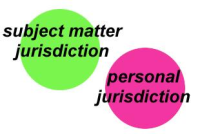
Above, we loosely talked about jurisdiction and I outlined two functions of jurisdiction. One function was to protect individuals. Another function was to protect the courts. Here, we explore these two types of jurisdiction. The first type of jurisdiction protects the individual from arbitrary and capricious state power. Lawyers call this personal jurisdiction. For a court to exercise power over an individual it must have personal jurisdiction over that individual. The second type of jurisdiction protects the courts. Lawyers call this jurisdiction subject matter jurisdiction. For a court to hear a case, it must have subject matter jurisdiction over the type of controversy at issue in the case.
Historically, personal jurisdiction derives from traditional notions of state power and from the Due Process Clause of the 14th amendment. The Due Process clause of the Constitution states:
This Constitutional language is vague. Thus, the Supreme Court has interpreted it over the years and in many cases. Before the drafting of the Constitution, courts had developed notions of personal jurisdiction based on the rights of sovereign states. The argument goes something like this: There are certain fundamental concepts of law. We call these foundational notions natural law and these concepts exist beyond constitutions, legal decisions, and statutes; States derive their existence from natural law. States have full power over individuals within their borders. This power over individuals within their borders is called jurisdiction; A state's power over an individual ends at its borders. A state can't usurp the powers of other states. Thus the jurisdiction of states, i.e. their power over individuals, has always been limited by concepts of sovereignty of states which in turn is based in natural law.
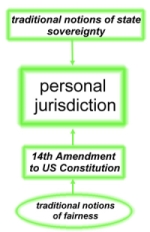 With the adoption of the 14th amendment, these ideas of state power were merged with
the idea of individual rights (basic human rights), another natural law concept.
As we discussed in the prior paragraph, the 14th amendment gives the individual protections from
the overarching powers of the state.
But this is only
part of the idea of "due process." The Court has interpreted the clause as giving
individuals the right of fair treatment in the courts of the land.
This idea of fair treatment is separate from the protection derived from old state
sovereignty concepts. It is also based in natural law, but derives from the idea
that there exist basic human rights, individual rights, that like concepts of sovereignty
are more fundamental than constitutions, statutes, or legal decisions.
So the due process clause
is laden with traditional concepts that limit the power of the state, and traditional
notions of the inherent rights of individuals (fundamental human rights). Neat huh?
With the adoption of the 14th amendment, these ideas of state power were merged with
the idea of individual rights (basic human rights), another natural law concept.
As we discussed in the prior paragraph, the 14th amendment gives the individual protections from
the overarching powers of the state.
But this is only
part of the idea of "due process." The Court has interpreted the clause as giving
individuals the right of fair treatment in the courts of the land.
This idea of fair treatment is separate from the protection derived from old state
sovereignty concepts. It is also based in natural law, but derives from the idea
that there exist basic human rights, individual rights, that like concepts of sovereignty
are more fundamental than constitutions, statutes, or legal decisions.
So the due process clause
is laden with traditional concepts that limit the power of the state, and traditional
notions of the inherent rights of individuals (fundamental human rights). Neat huh?
You may be asking, "how does all this play out in the real world." Well, basically, it means that if you are not present in the state or if you can't be served with process then the court can't get power, i.e. jurisdiction, over you. And once a state does get jurisdiction over you, you must be treated fairly in accordance with fundamental individual rights.
 The other category of jurisdiction is subject matter
jurisdiction.
We talked above about how legislatures limit access to courts to protect them from over use.
In the above example, I said that that Congress has limited the jurisdiction of federal courts
by forbidding them to hear divorce cases.
The other category of jurisdiction is subject matter
jurisdiction.
We talked above about how legislatures limit access to courts to protect them from over use.
In the above example, I said that that Congress has limited the jurisdiction of federal courts
by forbidding them to hear divorce cases.
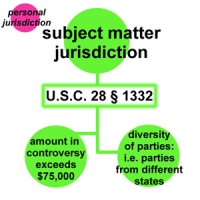
Congress has limited the subject matter jurisdiction of the federal courts in fundamental ways. First, the framers of the constitution were concerned about the prejudice to certain defendants. Therefore, they limited the subject matter jurisdiction of federal courts by requiring that there be complete diversity between plaintiffs and defendants. Full diversity means that the plaintiff and the defendant must be from different states to sue in federal court (it is, in reality, a little more complicated than this). For example, a plaintiff from Atlanta can sue a defendant from Los Angeles; but if the Georgia plaintiff tries to sue another Georgia defendant, then there can't be complete diversity. Thus, subject matter jurisdiction doesn't exist and the plaintiff's suit will fail. Subject matter jurisdiction diversity requirement is constitutional. Article III, Section 2 states that federal court jurisdiction extends to citizens of different states.
Don't confuse subject matter jurisdiction with personal jurisdiction. Remember, personal jurisdiction is concerned with individual rights based on the 14th amendment. Here, the Framers wanted to make sure that diverse defendants have the protections of the federal court forum. In the past, local prejudice existed in small state courts. Defendants could hope for a fairer and more impartial trial in the federal forum. At the same time, The Framers didn't want to open the federal courts to everybody; it enacted the diversity of citizenship requirement to keep the door open for foreign defendants. But they closed the door on local suits where prejudice shouldn't be a problem.
Second, Congress has limited the subject matter jurisdiction of the federal courts by requiring the amount in controversy in the law suit to exceed $75,000. This keeps the federal courts from being flooded by small cases.
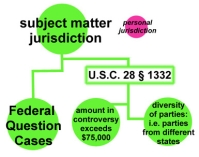
I've been sneaky. Now, I must level with you. I didn't tell you something very important because I wanted you to understand personal and subject matter jurisdiction. The federal courts always have subject matter jurisdiction to suits involving federal questions. This means that federal courts can always hear questions arising under federal statutes and the Constitution. This type of subject matter jurisdiction is called federal question jurisdiction.
- diversity
- amount in controversy
- federal question
This section has been hard to find a home for. I put it here because civil procedure does deal with the history of jurisdiction and traditionally equity was a separate jurisdiction from law. The story is somewhat interesting. I contemplated editing this section out but feel that a tangential understanding of equity might be helpful.
This section of the site should give you a brief introduction to some of the major concepts of civil procedure. Of course it is by no means comprehensive. What I want you to walk away with is a basic understanding of a few concepts. First, You should know that your civil procedure course will focus on the federal courts. You should know that there are basically two types of jurisdiction (there are others such as in rem jurisdiction but I leave that for you to discover). The first type is personal jurisdiction. The second is subject matter jurisdiction. You should be aware of the distinction between courts of law and courts of equity. You should know that the Federal Rules of Civil Procedure govern federal courts.