Tort means twisted.
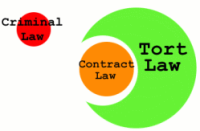 A fuller definition
of tort is a civil wrong other than a contract that is a valid claim
in a law suit. Some say
that tort is the garbage bag of the law because
it's an easy place to stuff most
actionable harms that can't be
classified elsewhere.
A fuller definition
of tort is a civil wrong other than a contract that is a valid claim
in a law suit. Some say
that tort is the garbage bag of the law because
it's an easy place to stuff most
actionable harms that can't be
classified elsewhere.
For our purposes, i.e. for a brief introduction to the law of torts, we're going to break the subject into 2 areas:
- intentional torts (those harms purposefully done), and
- negligence torts (those harms done unintentionally)
Negligence is a legal magic word. In the normal world, the word means that you did something sloppily. In the legal world, its definition is a little more precise. There are essentially four parts to negligence.
- Conduct that is unreasonable,
- a duty to whomever has been harmed,
- there must be a close causal connection between the unreasonable act and, the harm done, and,
- there must be actual harm caused by the unreasonable act.
The first element that a plaintiff must show to succeed in a negligence action against a defendant is unreasonable conduct on the part of the defendant.
How do we determine if the defendant's conduct in a particular situation is unreasonable? We compare his conduct with what a reasonably prudent person would have done. This reasonably prudent person standard is also called the objective standard of care.
Remember, an objective standard is a standard devoid of personal feelings or caprice. A subjective finding of what is reasonable behavior would consist of personal feelings and opinions and would necessarily be different in every court case. What I think is reasonable is definitely different than what you think is reasonable.
The reasonable person standard is drawn from the general consensus of the community, economic imperatives, and even political influences. The standard is, not surprisingly, a very vague one. It is often ambiguous as to exactly what the reasonable person should or would do in a given situation.
An example might help. Suppose a defendant is driving a car with severely worn tires which blow out and cause the plaintiff, who was a passenger in the car, to be injured. One of the issues at trial is did the defendant act unreasonably. One court held that individuals should know if their tires are in good condition. If a defendant is driving on worn-out tires, then he is acting in an unreasonable fashion. According to the court, the reasonably prudent driver never operates his vehicle with worn tires.
How did the court determine with such authority what the reasonably prudent person would do when faced with this new situation? Well, the court fudged a little. It wasn't really concerned with what a prudent person would do. In fact it was more concerned with the problem of saving lives. Thus, instead of surveying 1000 people to see if they knew the condition of their tires, the court derived an economic argument. The cost of forcing individuals to be responsible for their tires is small in relation to the value of the lives and property destroyed by car accidents caused by bald tires. And the driver is in the best position to defray that cost. Thus, in this case at least, the determination of what is reasonable was really a determination of what is most efficient.
The second element that a plaintiff must show to succeed in a tort action is a duty owed to the party harmed.
There are two popular theories of duty in Tort law. First, tortfeasors (i.e. people who commit torts) owe a duty to those victims whom the tortfeasor could have foreseen would be injured by his conduct. As an example, the injured passenger in our car would most likely be a foreseeable victim of our failing to keep our tires maintained.
The other theory of tort liability is that we owe a duty to the entire world not to conduct tortious activity.
So, what does all this mean? Practically, not much. Prosser, the Master of Tort Law, says that courts will usually find a duty where reasonable persons would assume a duty.
In our tire example, if the defendant is found to have acted unreasonably with respect to the standard of care, the plaintiff must still show that the defendant owed him a duty. Reasonable persons would most likely conclude that a driver of a vehicle owes a passenger a duty. Why? well. . . Let's pretend we are a Judge and come up with a few reasons. . .
First, the driver is in control of the vehicle and the passenger probably assumed that he would maintain the car in a reasonable fashion. Second, the driver is in the best position to manage the risks associated with maintaining a car so the burden of not conforming to a reasonable standard should reside with him.
Duty is an ambiguous concept and we could find a plethora of arguments for and against any position that proclaims a duty. That's what lawyers are paid to do.
You have heard of some of the intentional torts - trespassing, assault, battery, slander, defamation. . . But have you ever stopped and asked yourself what constitutes battery, or slander? At what level of conduct have I assaulted someone? Does yelling at a person constitute battery? (no, yelling at someone isn't battery).
If you've asked yourself these questions, you're on your way to understanding intentional torts. The intentional torts work like puzzles. Each type of intentional tort has a number of required pieces (or elements), and once you have all of them in place the picture is complete.
Look at the diagram. There are a finite number of intentional torts, and the diagram lists a small sample of the ones you'll study. A plaintiff can't just go into court and make up a new intentional tort. You have to plead an existing tort and all of its constituent elements or you will lose on summary judgment. That is, the defendant will claim you have not pleaded a recognized tort; therefore, no tort has been committed.
Juries determine whether a defendant has committed a tort by comparing the required elements for that tort to the defendant's conduct. Let's take the elements of battery as an example. (There's a great case and its brief involving battery on the site: Garratt v. Dailey).
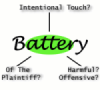
- An intentional touch by the defendant
- to the person of the plaintiff
- that is harmful or offensive to the plaintiff
If you have all of these elements then you have a battery. Let's go through them. First, ask yourself was there a touching of the plaintiff by the defendant? Then ask, was it the defendant's intent to touch the plaintiff. Finally, ask yourself was that touch harmful or offensive. Your Torts exam will work exactly like this.
We can break the study of torts into two major camps: Intentional torts and torts of negligence. You will be introduced to the standard of care when you study negligence torts. Initially this standard is defined as an objective one: What a reasonably prudent person would do in the same situation. During the semester, you will expand this definition of the reasonable person to cover torts committed by doctors, children, and professionals. You also will study the standard of care required by a landowner with respect to different classes of people entering on her land.
The study of torts isn't difficult. You're ahead of the game if you understand the idea of an objective standard of care. Also, understand that there are a finite set of intentional torts made up of specific elements.