The style of the case is the information at the top of the opinion. During my first months of law school, the style mystified me. Watch out, a Professor will put someone on the spot by asking him questions on information found within the style.
If a case were called Bailey v. West, its style might look like
this:
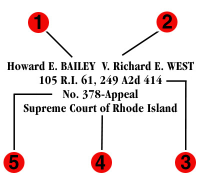
1. The first line of the style identifies the parties to the suit but (unfortunately) you can't discern the identity of the plaintiff or of the defendant by looking at it. Therefore, we don't know if Bailey or West is the plaintiff in this case because different appellate courts have different conventions for naming cases. In the trail court, the plaintiff is always mentioned first but some appellate courts first cite the party bringing the appeal. If that party wasn't the plaintiff in the trial court then the names will be reversed. You can usually find out the identity of the parties by reading the opinion, but sometimes the opinion never mentions the parities by name and refers to them exclusively as plaintiff and defendant. In these types of cases, you will never know the identity of the parties. Since our opinion, Silver v. Starrett, is from a trial court, we can be assured that the plaintiff is Silver and the Defendant is Starret. Our lives are made even easier by the Silver court because it tells us directly in the style that Silver is the plaintiff and Starrett is the defendant. Also, note how in the diagram "BAILEY" and "WEST" appear in caps. The reporter is telling us that when we cite this case, the only words that matter in the first line of the style are "Bailey" and "West." That is, the proper way to cite to this case's name in any legal document is Bailey v. West. In our case, the court has written Silver and Starrett in all caps in the Style; this informs us that the correct name of the case in legal documents is Silver v. Starrett.
2. Number 2, like number 1 points to the name line of the style. Again, we can't tell right off if West is the defendant or the plaintiff. We can say that West is a participant in a law suit or a litigant.
3. Number 3 is the cite line of the style. It shows us the correct way to cite the opinion in a legal document. This part of the style confused me during the first weeks of law school. To make matters worse, I didn't know where to turn to find out what all those strange numbers and letters meant. The numbers correspond to volume and page numbers of books called reporters. Reporters are special legal books that document cases in the appellate and supreme courts of the states. There are two different systems of reporting for the states. First, some states such as Rhode Island publish their own legal opinions. Soon all of the states will publish their legal opinions online as the demand for access to information increases due to the internet. Taking our example, the numbers. 105 R.I. 61, mean that in the 105th volume of the Rhode Island Reporter, on page 61, you will find the case Bailey v. West. West legal publishers is the second publishing system, thus the second group of numbers. These other numbers refer to the volume and page number of the Atlantic reporter published by West where we find Bailey v. West. The Atlantic Reporter 2d (referred to as the "Atlantic Reporter, Second,") is the second volume of the Atlantic Reporter. The first edition contains older cases - when a series of reporters gets too big, another is started. The Atlantic 2d is not published exclusively for the Rhode Island courts, and the reporter contains decisions of other state supreme and appellate courts in the Atlantic State Region.
4. The last line of the style tells us that this is a supreme court of Rhode Island Case as opposed to an Rhode Island appellate case or a case from another Atlantic Reporter State.
5. "NO. 348-appeal," is the docket number - This is
a number that the Supreme Court of Rhode Island assigns to the case to
keep its own house in order.